The record median home price for an existing home reached $440,600 in June 2026, but that does not mean buying has become any easier. If you have been watching the housing market and thinking, “Surely prices have to come down eventually,” the latest numbers may feel discouraging. The median price of an existing home reached […]
The record median home price for an existing home reached $440,600 in June 2026, but that does not mean buying has become any easier.
If you have been watching the housing market and thinking, “Surely prices have to come down eventually,” the latest numbers may feel discouraging.
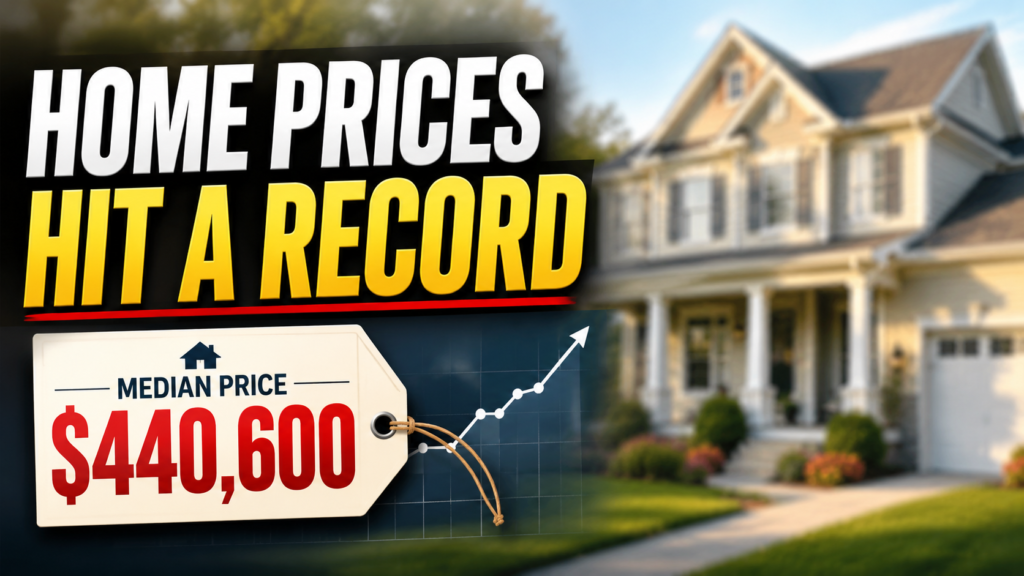
The median price of an existing home reached a record $440,600 in June 2026, according to the National Association of Realtors.
That was 1.8% higher than a year earlier and marked the 36th consecutive month of year-over-year price increases.
At the same time, home sales slowed from May, mortgage rates remained in the mid-6% range, and many buyers continued struggling to find something affordable.
So what is actually going on?
The quick answer is that more homes may be available than there were a year ago, but supply, prices, mortgage rates, and buyer demand are not moving evenly.
Some local markets are becoming more buyer-friendly. Others remain expensive and competitive.
What Does a Record Median Home Price Really Mean?
The median is the middle sale price. It does not mean every home in America now costs $440,600.
Roughly half of the homes sold for more than the median and half sold for less.
Your local market may be far above or below the national figure.
The number can also change depending on which homes sell during a particular month. If a larger share of expensive homes closes in June, the national median can rise even while individual sellers in some markets reduce their asking prices.
That distinction matters.
Realtor.com reported that national asking prices fell 2.5% from a year earlier in June. Meanwhile, the median price of homes that actually sold reached a record.
Those two facts may sound contradictory, but they measure different things.
The asking price reflects what sellers hope to receive when they list a property. The sales price reflects completed transactions.
A seller can reduce the asking price and still close at a historically high price compared with several years ago.
More Homes Are for Sale, but Buyers Still Feel Stuck
There were approximately 1.56 million existing homes available for sale at the end of June, according to NAR.
That represented about 4.6 months of supply at the current sales pace.
More inventory can help buyers. It may create additional choices, reduce pressure to make an immediate offer, and give buyers more room to negotiate.
But there is an important difference between more inventory and more affordable inventory.
A buyer may see dozens of listings online and still struggle to find a home that is:
- Located where they need to live
- In acceptable condition
- Large enough for their household
- Within a comfortable price range
- Eligible for their preferred mortgage program
- Affordable after taxes, insurance, maintenance, and possible HOA dues
That is why the market can technically have more homes for sale while buyers still feel as though they have very few realistic options.
Why Are Prices Rising If Sales Are Slowing?
Existing-home sales fell 2.4% from May to a seasonally adjusted annual rate of 4.09 million in June.
Normally, slower sales might be expected to push prices down quickly.
Housing does not always work that neatly.
Many current homeowners have mortgage rates well below the rates available today. Selling could mean giving up a lower payment and buying another home with a much more expensive loan.
That can make owners reluctant to list unless they truly need to move.
Demand has not disappeared either.
People still get married, have children, change jobs, retire, relocate, or need a different type of home.
When motivated buyers compete for a limited number of desirable and affordable properties, prices can remain firm even while the overall market feels slow.
Mortgage Rates Are Still a Major Part of the Problem
Freddie Mac reported that the average 30-year fixed mortgage rate was 6.55% on July 16, 2026.
That does not mean every borrower will receive 6.55%. Individual offers depend on credit, down payment, loan type, points, property details, lender pricing, and other factors.
Still, the national average helps show why affordability remains difficult.
Consider the record median sale price of $440,600.
A 20% down payment would equal $88,120, leaving a mortgage of $352,480.
At an illustrative 6.55% interest rate on a 30-year fixed mortgage, the principal-and-interest payment would be approximately $2,240 per month.
That payment does not include:
- Property taxes
- Homeowners insurance
- Mortgage insurance, when applicable
- Homeowners association dues
- Maintenance
- Repairs
- Utilities
The complete monthly cost could be several hundred dollars higher, depending on the property and location.
Use the Loan Under Review mortgage calculators to compare payments and different interest-rate scenarios:
Why a Small Rate Change Matters So Much
When home prices are already high, even a modest difference in the mortgage rate can noticeably change the monthly payment.
That is why buyers often feel frustrated when they hear that rates moved by “only” a quarter of a percentage point.
On a large mortgage, that small percentage applies to hundreds of thousands of dollars over many years.
The difference may affect:
- The monthly payment
- The amount a buyer can comfortably spend
- The amount of cash needed to qualify
- The debt-to-income ratio
- The total interest paid over time
This does not mean buyers should try to predict the perfect week to apply.
It means they should compare actual loan estimates and understand how different rates, points, and down payments affect the full cost.
Does the Record Price Mean Buyers Should Give Up?
No.
A national record does not mean every local seller has the upper hand.
Housing conditions vary dramatically by city, neighborhood, price range, and property type.
Realtor.com found that asking prices declined in many areas, especially across parts of the South and West.
Some buyers may now encounter:
- Price reductions
- Longer listing times
- Fewer competing offers
- Seller-paid closing costs
- Repair negotiations
- Mortgage-rate buydown offers
- Builder incentives on new homes
Other buyers may still face multiple offers and very limited entry-level inventory.
The important question is not whether the entire national market favors buyers or sellers.
The better question is:
“What is happening in my price range, in the neighborhoods I am considering, and with the type of home I need?”
A Lower Price Is Not Always the Better Deal
Buyers often focus on negotiating the purchase price, but the financing terms can make just as much difference.
Imagine two similar homes.
One seller accepts a lower price but refuses to contribute toward closing costs.
Another seller holds firmer on price but agrees to help with closing expenses or fund a temporary mortgage-rate buydown.
The second offer could potentially require less cash upfront or create a lower initial payment.
That does not automatically make it the better choice. Buyers need to compare the complete transaction rather than focusing on one number.
Important details include:
- Purchase price
- Interest rate
- Discount points
- Closing costs
- Seller concessions
- Mortgage insurance
- Property taxes
- Insurance
- HOA dues
- Expected repairs
- Ongoing maintenance
A home that looks cheaper on the listing page may cost more once everything is included.
Are Buyers Actually Getting More Negotiating Power?
In some markets, yes.
When a home sits for several weeks, receives few offers, or needs repairs, the seller may become more flexible.
That flexibility could involve the price, closing date, repairs, included appliances, or help with closing costs.
However, buyers should not assume every seller is desperate.
A well-priced home in good condition can still attract strong interest, especially when it falls within an affordable price range.
Entry-level homes often face more competition because a larger group of buyers is trying to stay below the same monthly-payment limit.
Buyers gain the most leverage when they understand the local market and avoid becoming emotionally attached before reviewing the numbers.
What Should Buyers Focus on Right Now?
Start with the monthly payment you can comfortably manage—not the largest amount a lender may approve.
That budget should leave room for:
- Groceries
- Transportation
- Utilities
- Insurance
- Childcare
- Emergency savings
- Retirement contributions
- Home maintenance
- Unexpected repairs
A lender evaluates whether a loan fits its underwriting requirements.
You must decide whether the payment fits your actual life.
Read more about the difference here:
Before touring homes, buyers should also consider getting prequalified or preapproved so they understand how their credit, income, debt, and available funds may affect their options.
That does not guarantee final approval, but it can reduce the risk of shopping in the wrong price range.
What Could Cause Home Prices to Cool?
Home prices could face more downward pressure if:
- Inventory rises consistently
- Mortgage rates remain elevated
- Buyer demand weakens
- Homes take longer to sell
- Sellers become more willing to negotiate
- Employment conditions deteriorate
- Construction adds meaningful supply
However, a nationwide price crash is not the only way affordability can improve.
Buyers may benefit from slower price growth, stable prices, falling mortgage rates, stronger wages, seller concessions, or more available inventory.
Housing affordability depends on more than the sale price alone.
What Could Keep Prices High?
Prices may remain elevated if desirable homes stay scarce and homeowners continue holding onto lower-rate mortgages.
Strong employment, population growth, household formation, limited construction, and competition for entry-level homes can also support prices in certain markets.
That is why national headlines can feel disconnected from what buyers see locally.
One city may have growing inventory and frequent price reductions. Another may still have too many buyers competing for too few homes.
The Bottom Line
The record $440,600 median existing-home price shows that buying a home remains expensive.
But it does not mean every home costs that much, every seller has complete control, or every market is moving in the same direction.
More inventory and falling asking prices in some areas may give buyers additional negotiating room.
At the same time, mortgage rates and high monthly payments continue limiting what many households can comfortably afford.
Buyers should focus less on dramatic national headlines and more on the complete cost of a specific home in a specific market.
Compare the payment, available cash, property condition, local inventory, and financing options before deciding what makes sense.
Loan Under Review provides general mortgage education and is not a lender, real estate brokerage, financial adviser, or legal adviser. Housing data and mortgage rates can change. Verify current information and evaluate decisions based on your finances and local market.
Mortgage guidelines and lender requirements can change. This article is general education, not financial, legal, lending, or appraisal advice. Confirm requirements for your situation with an appropriate qualified professional.