On This Page
On This Page- Quick Answer: Do You Need 20% Down to Buy a House?
- What Zillow's 8.5-Year Estimate Really Says
- See What the Down Payment Difference Looks Like
- What Do You Gain by Putting 20% Down?
- You borrow less
- You can usually avoid PMI on a conventional loan
- You start with more equity
- So Why Would Someone Put Less Than 20% Down?
- Conventional Loans Can Start Below 20%
- What about PMI?
- FHA Can Bring the Down Payment to 3.5%
- VA Can Change the Down-Payment Conversation Completely
- USDA Can Offer Another Zero-Down Option
- The Down Payment Is Not All the Cash You Need
- A Smaller Down Payment Does Not Fix an Unaffordable Payment
- Should You Wait Until You Have 20%?
- Run More Than One Scenario
- The Question Is Bigger Than 20%
Zillow estimates it can take a typical household 8.5 years to save 20% down. But many mortgage programs allow less. Here is what buyers should compare before deciding to wait.
Published: August 24, 2026
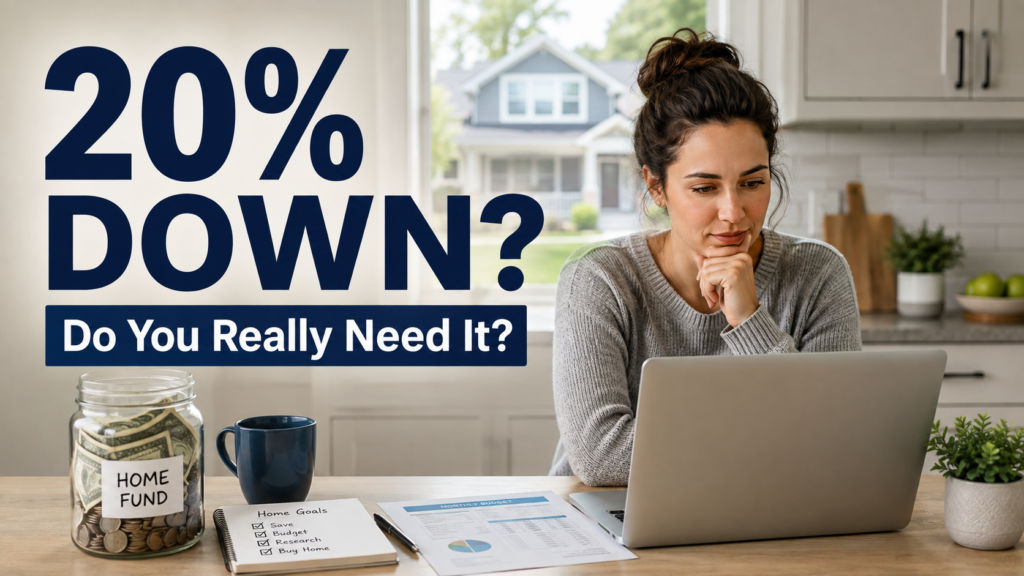
Saving for a house is hard enough without aiming for a number you may not actually need.
Zillow recently estimated that a typical U.S. household saving 10% of the area’s median income would need about 8.5 years to build a 20% down payment on a typical single-family home.
Eight and a half years is a long time.
But there is an important detail behind that number.
Zillow calculated how long it would take to save 20% down. It did not say buyers are required to put 20% down before they can get a mortgage.
Many are not.
Some conventional loans allow qualified borrowers to put as little as 3% down. FHA loans can allow 3.5% down. Eligible VA borrowers may be able to buy with no down payment, and USDA offers 100% financing for eligible borrowers and properties.
So if you have been waiting because you thought 20% was the price of admission, it may be worth taking another look at the numbers.
That does not mean you should rush out and buy a house with the smallest down payment possible.
It means 20% is a financial choice, not a universal rule.
Quick Answer: Do You Need 20% Down to Buy a House?
Usually, no.
The Consumer Financial Protection Bureau says some conventional loans backed by Fannie Mae or Freddie Mac can require as little as 3% down. FHA loans can require as little as 3.5% down.
Eligible VA borrowers can have the option of purchasing without a down payment, subject to VA eligibility and lender requirements.
USDA’s guaranteed loan program also offers 100% financing to eligible borrowers purchasing qualifying homes in eligible areas.
Twenty percent still matters.
Putting that much down can reduce your loan balance, give you more equity immediately, and generally allow a conventional borrower to avoid private mortgage insurance.
But those are advantages of putting 20% down.
They are not proof that everyone needs 20% before buying.
What Zillow’s 8.5-Year Estimate Really Says
Zillow’s August 20, 2026 analysis looked at two separate parts of buying a home.
First, how long would it take a household to save for a 20% down payment?
Then, after purchasing, how long would it take before owning came out ahead financially compared with renting?
Nationally, Zillow calculated 8.5 years to save the down payment and another 6.2 years to reach its rent-versus-buy break-even point.
That produced a combined timeline of about 14.7 years for a typical single-family home.
Zillow also found a much shorter timeline for starter homes. Its national estimate for saving and reaching the break-even point on a starter home was about 7.2 years combined.
There is useful information in those numbers.
But a buyer should not read the 8.5-year figure and automatically think, “I have to wait eight years before I can buy.”
That is not what the calculation means.
It means saving 20% can take a very long time.
Whether you actually need 20% is a different question.
See What the Down Payment Difference Looks Like
Take a $400,000 home.
Here is the basic down-payment math:
| Down payment | Cash down |
|---|---|
| 20% | $80,000 |
| 10% | $40,000 |
| 5% | $20,000 |
| 3.5% | $14,000 |
| 3% | $12,000 |
That is a huge difference in cash.
Going from an $80,000 target to a $20,000 target does not mean the home suddenly became cheaper.
It means you are financing more of the purchase.
That affects your loan balance, monthly payment, mortgage insurance, equity, and potentially other loan costs.
This is why down-payment conversations can get misleading when they stop at, “You only need 3%.”
A lower minimum down payment can make buying possible sooner.
It does not make the additional borrowed money disappear.
Before choosing a target, run the same home price through the Loan Under Review Mortgage Calculator using several different down-payment amounts.
Compare the full monthly payment, not just principal and interest.
What Do You Gain by Putting 20% Down?
There is a reason 20% gets so much attention.
It can be a very useful down-payment target if you can reach it without creating other financial problems.
You borrow less
This part is simple.
Put $80,000 down on a $400,000 home and your starting loan amount is much lower than if you put $20,000 down, before accounting for any financed fees or other adjustments.
Less borrowed principal can mean a lower monthly principal and interest payment and less interest paid over time.
You can usually avoid PMI on a conventional loan
Private mortgage insurance, or PMI, is commonly required when a conventional borrower puts less than 20% down.
PMI protects the lender if the borrower defaults. It does not protect the homeowner.
The CFPB notes that buyers putting less than 20% down will likely need mortgage insurance, depending on the loan.
Avoiding PMI can make a noticeable difference in the monthly payment.
You start with more equity
Put 20% down and you begin with a larger ownership stake in the property.
Put 3% or 5% down and there is less room between the home’s value and the mortgage balance.
That does not automatically make a small down payment bad.
It is simply a tradeoff worth understanding.
So Why Would Someone Put Less Than 20% Down?
Because getting from 5% to 20% can mean saving tens of thousands of additional dollars.
For some households, that could take years.
During those years, rent continues to be paid. Home prices can move. Mortgage rates can move. Income can change. Life can change.
None of those things are predictable enough to say buying earlier will always work out better.
But waiting is not automatically the safer or cheaper decision either.
A buyer who can comfortably afford the payment, has money left after closing, qualifies for an appropriate mortgage program, and plans to stay in the home for a meaningful period may decide that waiting several more years just to reach 20% does not make sense.
Another buyer may look at the higher payment and mortgage insurance that come with putting less down and decide waiting is worth it.
Both decisions can be reasonable.
The important part is knowing what you are comparing.
Conventional Loans Can Start Below 20%
Conventional does not mean 20% down.
The CFPB says conventional mortgages backed by Fannie Mae and Freddie Mac can require as little as 3% down in some cases.
Fannie Mae’s HomeReady program, for example, offers eligible borrowers down payments as low as 3%.
Freddie Mac also has low-down-payment options, including Home Possible and HomeOne for eligible borrowers and transactions.
The catch is that eligibility matters.
Income limits can apply to some programs. Occupancy requirements can apply. Credit, debt-to-income ratio, property type, loan amount, automated underwriting findings, and lender requirements can also affect what is available to a particular borrower.
A 3% down payment appearing on a program page does not mean every buyer will qualify for it.
What about PMI?
This is one of the biggest costs to compare.
A conventional loan with less than 20% down will commonly include PMI.
That means you should compare:
- the monthly payment
- PMI
- cash needed at closing
- cash left after closing
- total loan amount
- interest rate and APR
Do not compare down-payment percentages in isolation.
Our Conventional vs FHA Loans guide goes deeper into the differences between those two loan types.
FHA Can Bring the Down Payment to 3.5%
FHA financing is another common option for buyers who do not have 20% available.
The CFPB says FHA loans can require as little as 3.5% down.
FHA loans are made by private lenders and insured by the Federal Housing Administration.
That insurance gives lenders additional protection, but the borrower pays for FHA mortgage insurance.
So on our $400,000 example, 3.5% down would be $14,000.
That is obviously easier to save than $80,000.
But you would also be starting with a much larger mortgage than the buyer who put 20% down.
The loan would have FHA mortgage insurance requirements too.
This is exactly why “FHA only needs 3.5% down” is not enough information to make a decision.
You have to look at the complete loan.
For more detail, read our FHA Loan Requirements Explained in Plain English guide.
VA Can Change the Down-Payment Conversation Completely
If you are eligible for a VA-backed home loan, the down-payment question can look very different.
The Department of Veterans Affairs says eligible borrowers using a VA-backed purchase loan may have the option to buy without making a down payment.
VA loans also do not use monthly PMI.
That does not mean the loan is free.
VA borrowers may pay a funding fee unless they qualify for an exemption, and buyers can still have closing costs and other expenses.
The lender will also review credit, income, and the rest of the loan file.
Still, for an eligible borrower, saving 20% simply because they think every mortgage requires it could mean waiting for a threshold their loan program does not require.
USDA Can Offer Another Zero-Down Option
USDA’s Single Family Housing Guaranteed Loan Program can provide 100% financing for eligible borrowers purchasing eligible properties.
USDA says the program is available to qualifying low- and moderate-income applicants and that household income generally cannot exceed 115% of the median household income for the purchase area. The home also has to be located in an eligible area and used as the borrower’s primary residence.
This is not just a first-time buyer program.
But USDA eligibility rules can quickly determine whether the program is even an option.
You can compare the programs in our USDA vs. FHA vs. Conventional Loans guide.
The Down Payment Is Not All the Cash You Need
This is one of the easiest mistakes to make when saving for a home.
You finally hit your down-payment goal and think you are ready.
Then closing gets closer and you realize there are other costs.
Depending on the transaction, buyers may need money for things such as:
- closing costs
- prepaid homeowners insurance
- property taxes and escrow deposits
- appraisal costs
- inspection costs
- moving expenses
- utility deposits
- repairs
- furniture or appliances
- emergency savings
The CFPB specifically recommends leaving room for moving expenses and other costs when deciding how much of your available cash to use for a down payment.
That creates an important question.
Would you rather put 20% down and have very little money left?
Or put somewhat less down and keep a larger emergency reserve?
There is no universal answer.
But emptying your savings account just to hit a round percentage deserves serious thought.
Owning a home gets expensive at inconvenient times.
Furnaces do not wait until your emergency fund recovers.
Neither do plumbing leaks, broken appliances, insurance deductibles, or surprise repairs.
A Smaller Down Payment Does Not Fix an Unaffordable Payment
This is where buyers need to be careful.
Reducing the down payment can solve a cash problem.
It does not necessarily solve an affordability problem.
If the monthly payment is already uncomfortable, borrowing more money to reduce the cash needed upfront may make the monthly budget even tighter.
That is why you should look beyond the purchase price and down payment.
A realistic housing payment can include:
- principal
- interest
- property taxes
- homeowners insurance
- mortgage insurance
- HOA dues
- other recurring housing expenses
Then there are costs lenders do not include in your mortgage payment, such as repairs and maintenance.
Also remember that mortgage approval and personal affordability are not the same thing.
A lender may approve a payment that is higher than you personally want to carry every month.
Our guide on how much house you can really afford explains that difference in more detail.
Should You Wait Until You Have 20%?
Maybe.
But “I need 20%” should not be the only reason.
Waiting can make sense if reaching 20% is realistic in the near future and doing so would leave you with a healthy emergency fund.
It can also make sense if the lower loan amount or removal of conventional PMI would make the monthly payment substantially more comfortable.
Buying with less than 20% may be worth exploring if waiting would take years, you qualify for an appropriate mortgage program, the payment fits comfortably, and you would still have enough savings after closing.
The length of time you expect to stay in the home matters too.
Zillow’s own analysis makes that point. Its research does not only look at how long it takes to save. It also looks at how long a homeowner may need to own the property before buying comes out ahead financially compared with renting.
Buying a home you expect to sell quickly can be a very different financial decision from buying one you expect to keep for ten years.
Run More Than One Scenario
If you are trying to decide whether to keep saving, do not run the numbers once.
Run them several times.
For the same home price, compare:
20% down
Look at the loan balance, monthly payment, and how much cash you would have left.
10% down
See what changes in the payment and mortgage insurance.
5% down
Compare the additional borrowing with the cash you would keep in savings.
3% or 3.5% down
If you qualify for a program that allows it, calculate the full payment and program costs.
VA or USDA financing
If you may be eligible, compare the zero-down structure with the other loans available to you.
The Loan Under Review Mortgage Calculator includes tools for mortgage payments, affordability, debt-to-income ratio, loan-to-value, down payments, PMI, and FHA mortgage insurance.
Use estimates that are realistic, not the most optimistic numbers you can find.
The Question Is Bigger Than 20%
Zillow’s 8.5-year estimate shows how difficult it can be for a typical household to build a traditional 20% down payment.
What it does not show is that every buyer has to wait until that account reaches 20%.
Some buyers will decide that putting 20% down is worth the wait.
Others may find that 10%, 5%, 3.5%, 3%, or an eligible zero-down program makes more sense for their situation.
Before deciding, look at three things together:
How much cash will you need to close?
What will the complete monthly payment look like?
How much money will you still have after you get the keys?
If those numbers do not work, a smaller down payment probably does not solve the problem.
If they do work, and you qualify for a mortgage program that requires less than 20%, then waiting years simply because you thought 20% was mandatory may not be necessary.
The percentage is only one part of the decision.
The payment, the loan costs, your savings, and what your finances look like after closing matter just as much.
Educational information only. Loan Under Review is not a lender. Mortgage programs, eligibility requirements, lender standards, insurance costs, fees, and underwriting rules can change. This article is general education and is not financial, legal, lending, tax, or appraisal advice. Confirm the requirements and costs that apply to your situation with an appropriate qualified professional.
Mortgage guidelines and lender requirements can change. This article is general education, not financial, legal, lending, or appraisal advice. Confirm requirements for your situation with an appropriate qualified professional.