On This Page
On This Page- Quick Answer
- That $1,800 Mortgage Payment May Be Only Part of the Bill
- Your Other Debts Count Too
- “But I’ve Already Proven I Can Make the Payment”
- The Lender Is Looking at the Whole Picture
- Income Can Be Another Surprise
- Credit Still Matters
- Then There Is the Cash Needed to Buy
- So Does Your Rent History Matter?
- Before You Decide You Cannot Buy, Run the Numbers
- And Remember: Approval Is Not the Same as Affordability
- The Bottom Line
- Sources
If you can consistently pay your rent, it can be frustrating to hear that you don't qualify for a similar mortgage payment. Here's what lenders are actually looking at and when positive rent history may help.
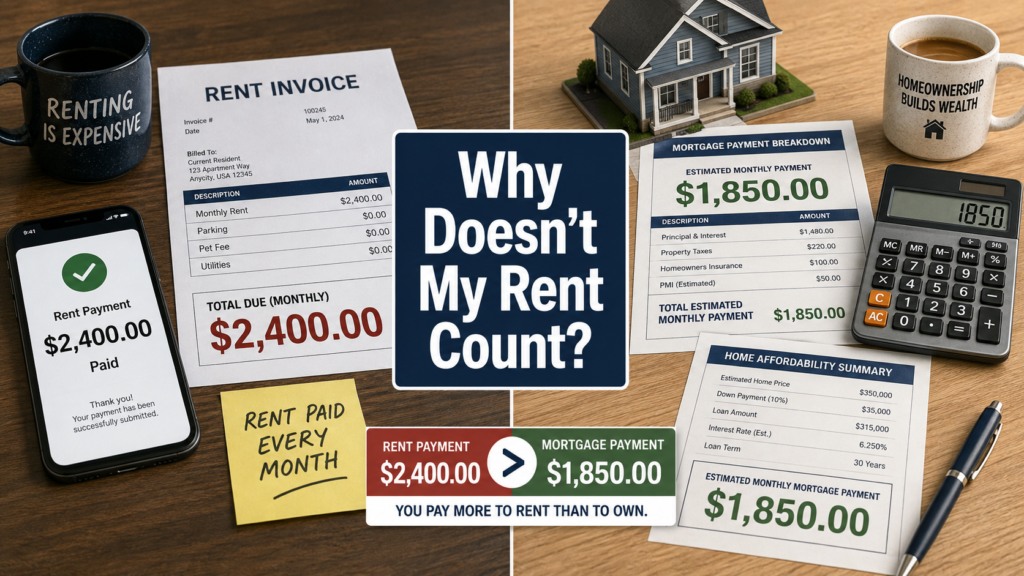
You pay $2,100 in rent every month.
It comes out of your account like clockwork. You’ve done it for two years, maybe five years, maybe longer.
Then you start looking at houses and somebody tells you that you may not qualify for a mortgage with a payment around $1,800.
Your first reaction is probably pretty simple:
“Wait. I already pay more than that in rent. How does this make any sense?”
That frustration is understandable.
But mortgage qualification doesn’t work by simply comparing your current rent with the principal-and-interest payment on a new mortgage.
There are a few more numbers hiding behind the scenes.
Quick Answer
Paying $2,100 in rent every month can show that you have experience managing a substantial housing payment.
But a mortgage lender still has to look at your income, monthly debts, credit history, available assets, down payment, loan program, property taxes, homeowners insurance, mortgage insurance, HOA dues and the property itself.
And here is the part that catches a lot of people:
An $1,800 mortgage payment may not actually mean an $1,800 total housing payment.
That $1,800 Mortgage Payment May Be Only Part of the Bill
Let’s say you find a house online and a calculator shows an estimated mortgage payment of $1,800.
Great.
You already pay $2,100 in rent, so it sounds like you would actually be saving money.
But look closely at what that $1,800 includes.
If it is just principal and interest, your real housing payment could also include property taxes, homeowners insurance, mortgage insurance and HOA dues.
Depending on the house and loan, those extra costs can add hundreds of dollars a month.
So the payment you thought was $1,800 might really be $2,200, $2,400 or something else entirely.
That doesn’t mean the house is unaffordable. It just means you need to compare the right numbers.
You can use the Loan Under Review mortgage calculators to test different prices, rates, down payments and monthly costs before assuming a home fits your budget.
Your Other Debts Count Too
Now let’s say the total housing payment still looks reasonable.
There is another piece.
Your lender also looks at other recurring debts.
Maybe you have a $650 car payment.
Maybe you have student loans.
Maybe you carry balances on a couple of credit cards.
Those payments can affect something called your debt-to-income ratio, or DTI.
DTI compares certain monthly debt payments with your gross monthly income.
So two people can both pay $2,100 in rent and still get completely different mortgage results.
One may have very little other debt.
The other may already be paying $1,500 a month toward cars, cards and student loans.
Same rent payment.
Very different mortgage file.
If you want to see how that works with your own numbers, the Loan Under Review Calculator Center includes tools for affordability, monthly payment and debt-to-income calculations.
“But I’ve Already Proven I Can Make the Payment”
This is the part where renters understandably get annoyed.
Because there is some truth in that argument.
If you have paid a large rent payment on time month after month, that does tell us something about how you handle housing expenses.
And the mortgage industry has gotten better at recognizing that.
Fannie Mae’s Desktop Underwriter can consider positive rent-payment history for eligible borrowers when qualifying information is available through certain credit or asset-verification data.
Freddie Mac’s Loan Product Advisor can also consider positive rental history as part of its risk assessment in eligible situations.
So no, your rent history is not necessarily meaningless.
But there is a catch.
Positive rental history can help an underwriting decision. It does not replace the rest of the mortgage requirements.
It does not erase a large car payment.
It does not automatically make every type of income usable.
It does not provide the money needed for closing.
And it does not guarantee mortgage approval.
The Lender Is Looking at the Whole Picture
Mortgage underwriting is basically the lender asking a long list of questions.
Can your income be documented?
Is that income stable enough to use under the loan guidelines?
What debts are you required to pay every month?
What does your credit history look like?
Do you have enough money available for the transaction?
Does the property meet the requirements of the loan?
Does the entire file fit the rules of the mortgage program?
Freddie Mac describes underwriting as the process of verifying employment, income, assets, debts and credit history while also making sure the mortgage amount makes sense in relation to the property.
That is why the answer cannot simply be:
“You pay $2,100 in rent, therefore you qualify for a $2,100 mortgage.”
Income Can Be Another Surprise
Sometimes borrowers know exactly how much money they make and are shocked when the lender comes up with a different qualifying number.
You might say:
“I made $80,000 last year. Why are you using less than that?”
Mortgage underwriting has rules for documenting and calculating income.
Overtime, bonuses, commissions, self-employment income and other variable income may need to be averaged or documented over a certain period.
A recent raise may help, but not every dollar of income automatically gets treated the way a borrower expects.
That can make it feel like the lender is looking at a completely different financial life.
They are really looking at the same finances through mortgage-program rules.
Credit Still Matters
Your rent history is only one piece of the credit picture.
A lender may also look at how you have handled credit cards, installment loans and other obligations.
That does not mean you need perfect credit to buy a home.
Different mortgage programs can treat borrowers differently.
For example, FHA and conventional loans can have different approaches to credit, mortgage insurance, down payment and underwriting.
Our guide to FHA vs. conventional loans explains some of those differences in plain English.
Then There Is the Cash Needed to Buy
This is another place where the rent-versus-mortgage comparison breaks down.
Maybe you can comfortably handle the monthly payment.
That is great.
But buying a home may also require money upfront.
Depending on the transaction, that could include a down payment, closing costs, prepaid property taxes, homeowners insurance, escrow deposits, inspection costs and other expenses.
Some loan programs allow low or even zero down payments for eligible borrowers.
But zero down does not always mean zero dollars needed at closing.
The lender has to make sure the entire transaction works, not just the monthly payment.
So Does Your Rent History Matter?
It can.
If you have been paying a substantial rent payment on time, it is reasonable to ask your loan officer whether that history can be considered in the automated underwriting system being used for your loan.
Do not assume it will change the decision.
But do not assume it is automatically ignored either.
Fannie Mae and Freddie Mac both have systems that may take positive rental history into account for eligible conventional mortgages. :contentReference[oaicite:1]{index=1}
Before You Decide You Cannot Buy, Run the Numbers
This is probably the most useful thing you can do.
Do not start with:
“I pay $2,100 in rent, so I should qualify for a $2,100 mortgage.”
And do not immediately jump to:
“The lender said no, so I will never be able to buy a house.”
Start with the actual numbers.
What is your gross qualifying income?
What monthly debts are being counted?
What would the full housing payment be after taxes, insurance and mortgage insurance?
How much cash would you need?
What happens if the purchase price is $25,000 lower?
What happens if you pay off a smaller debt?
What happens with a different mortgage program?
The Loan Under Review mortgage calculator center lets you test several of those scenarios without guessing.
And Remember: Approval Is Not the Same as Affordability
There is another side to this whole conversation.
Sometimes a lender approves someone for more than they actually feel comfortable spending.
That is why qualification and affordability are not the same thing.
A lender may say the numbers work.
Your own budget may say otherwise.
We explain that difference in more detail in How Much House You Can Really Afford — Not What a Lender Approves.
If you are just starting the process, you can also browse the Loan Under Review First-Time Buyers section for additional guides on financing, underwriting and preparing to buy.
The Bottom Line
If you can afford your rent, why can’t you automatically qualify for a mortgage with a similar payment?
Because a mortgage lender is looking at much more than the size of your rent check.
The lender is looking at income, debts, credit, assets, the full proposed housing payment, the property and the rules of the loan program.
But your rent payment history may still matter.
For some eligible conventional borrowers, positive rent history can now be considered in automated underwriting.
So if you have been making a large rent payment on time every month, bring it up.
Then look at the whole mortgage picture.
Sometimes the problem is not that you cannot handle the payment.
It may be one debt, one income-calculation issue, one credit issue or one other part of the file that is changing the result.
Finding that piece is much more useful than simply hearing, “You don’t qualify.”
Sources
- Fannie Mae — Positive Rent Payment History in Desktop Underwriter
- Freddie Mac — Loan Product Advisor
- Consumer Financial Protection Bureau — Debt-to-Income Ratio
- Freddie Mac — What Is Mortgage Underwriting?
Educational information only: Loan Under Review provides independent mortgage education and is not a lender. Mortgage qualification depends on the loan program, lender requirements, borrower circumstances and property. Calculator results are estimates and are not a preapproval, loan offer or commitment to lend.
Mortgage guidelines and lender requirements can change. This article is general education, not financial, legal, lending, or appraisal advice. Confirm requirements for your situation with an appropriate qualified professional.