On This Page
On This Page- Mortgage Rates Remain Elevated
- The 10-Year Treasury Is Sending a Warning
- Why Treasury Yields Have Been Rising
- The Fed Meets July 28 and 29
- What Would Need to Happen for Mortgage Rates to Fall?
- What Higher Treasury Yields Mean for Buyers
- Should Buyers Wait for the Fed Meeting?
- Do Not Confuse Approval With Affordability
- What Buyers Should Watch This Week
- The Bottom Line
- Sources
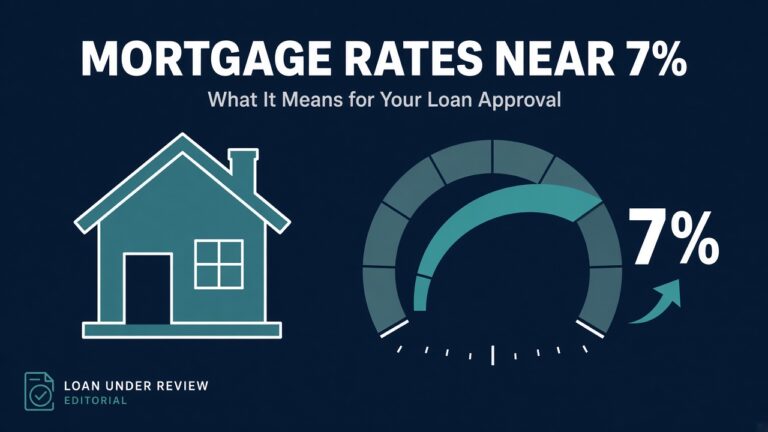
Mortgage rates remain near their highest levels of 2026 as the 10-year Treasury yield approaches 4.7%. Here is what buyers should watch during the Federal Reserve meeting and what could finally push mortgage rates lower.
Mortgage rates ended last week near some of their highest levels in almost a year.
Now the Federal Reserve is about to meet, which means buyers will hear plenty of predictions about rate hikes, rate cuts, pauses, and what the Fed may do next.
But there is one important detail that gets lost in most of that coverage.
The Federal Reserve does not directly set mortgage rates.
For buyers trying to understand where mortgage rates may go next, the 10-year Treasury yield may be the more useful number to watch.
Quick answer: Mortgage rates are under pressure because longer-term Treasury yields remain elevated. The Fed’s July 28 and 29 meeting could move the bond market, but mortgage rates will respond more to how investors interpret inflation, oil prices, economic growth, and future Fed policy than to the headline decision alone.
Mortgage Rates Remain Elevated
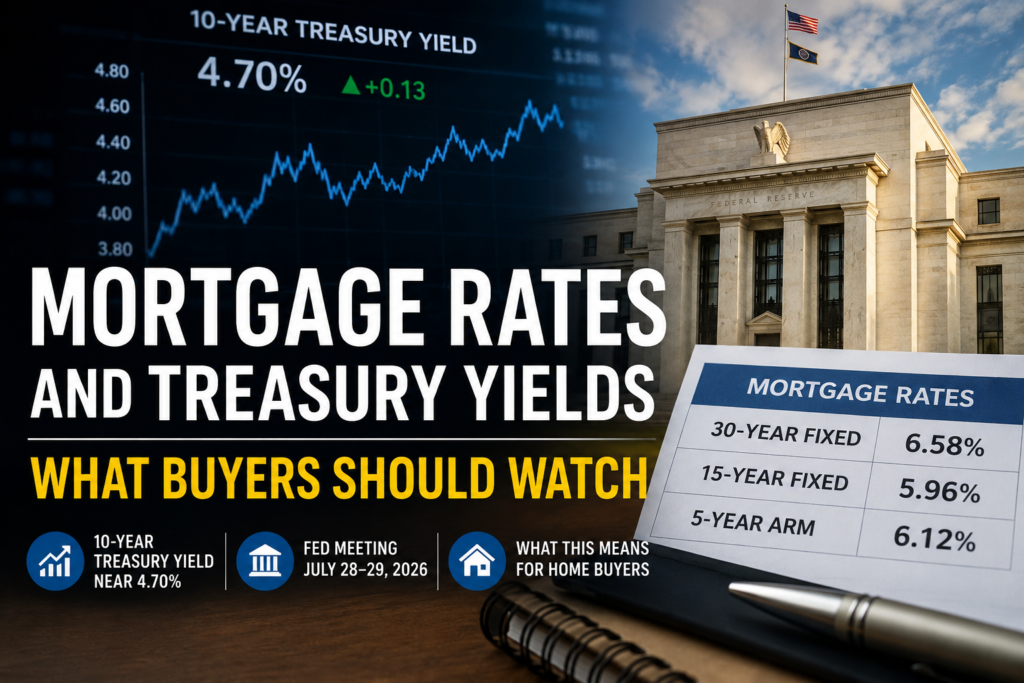
Freddie Mac reported that the average 30-year fixed mortgage rate increased to 6.58% for the week ending July 23, 2026.
That was up from 6.55% the previous week and marked the third consecutive weekly increase.
The average 15-year fixed mortgage rate also increased, rising from 5.93% to 5.96%.
Those averages remain below 7%, but they do not tell the entire story.
Daily mortgage pricing can move faster than Freddie Mac’s weekly survey. Depending on the borrower, lender, loan program, points, credit profile, and lock period, some buyers may already be receiving quotes much closer to 7%.
That is why the market’s recent movement matters even if the national weekly average has not crossed that line.
Our earlier update on mortgage rates creeping toward 7% explains why different rate sources can show different numbers without necessarily contradicting one another.
The 10-Year Treasury Is Sending a Warning
Mortgage rates generally move in the same direction as the 10-year U.S. Treasury yield.
They do not move perfectly together, and mortgage rates are normally higher. But when the 10-year yield rises quickly, lenders frequently face pressure to raise mortgage pricing.
The 10-year Treasury yield reached approximately 4.7% last week.
That was up from about 4.57% one week earlier and significantly higher than the 3.97% level recorded in late February.
That is a large enough move to affect borrowing costs.
Higher Treasury yields mean investors are demanding greater returns before lending money for longer periods. Mortgage-backed securities must then compete with those higher-yielding government bonds for investor demand.
Lenders generally respond by raising mortgage rates, increasing points, reducing lender credits, or making some combination of those changes.
For a deeper explanation of this connection, read why the 10-year Treasury yield affects mortgage rates.
Why Treasury Yields Have Been Rising
Several concerns are hitting the bond market at the same time.
The first is inflation.
Oil prices have moved sharply because of renewed conflict and uncertainty in the Middle East. Higher energy prices can eventually affect transportation, shipping, manufacturing, food production, utilities, and consumer prices.
Bond investors care about inflation because it reduces the future purchasing power of the fixed interest payments they receive.
When investors become more concerned about inflation, they may demand higher yields.
The second issue is the strength of the economy.
A resilient economy sounds positive, and in many ways it is. But stronger growth can also make investors believe the Federal Reserve will need to keep interest rates elevated for longer.
The third issue is uncertainty surrounding future Fed policy.
Markets became accustomed to the Federal Reserve giving substantial guidance about what it planned to do next. Current Fed leadership has taken a less predictable approach, placing more emphasis on incoming economic data.
That uncertainty can create larger moves in Treasury yields as traders repeatedly adjust their expectations.
The Fed Meets July 28 and 29
The Federal Open Market Committee is scheduled to meet on Tuesday, July 28, and Wednesday, July 29.
The policy announcement is scheduled for Wednesday afternoon, followed by a press conference.
Most borrowers will naturally focus on whether the Fed raises, lowers, or holds its short-term benchmark rate.
The decision matters, but the wording may matter just as much.
Bond investors will be listening for clues about:
- Whether the Fed believes inflation risks have increased
- How policymakers view the recent rise in oil and energy prices
- Whether the economy remains stronger than expected
- Whether additional rate increases are possible
- Whether rate cuts have been pushed further into the future
- How confident officials are that inflation will return to their target
The mortgage market may react even if the Fed leaves its benchmark rate unchanged.
A statement that sounds more concerned about inflation could push Treasury yields and mortgage rates higher.
A statement that reassures investors could allow yields to fall and provide some relief for mortgage pricing.
This is why “the Fed held rates steady” does not automatically mean mortgage rates will remain steady too.
Our guide to what actually drives mortgage rates explains why the Fed is only one part of the mortgage pricing system.
What Would Need to Happen for Mortgage Rates to Fall?
A meaningful mortgage-rate decline will probably require more than one favorable trading day.
First, the 10-year Treasury yield would likely need to move lower and remain lower.
A brief decline can improve daily mortgage pricing. A sustained decline gives lenders more confidence to make larger adjustments.
Second, oil prices and geopolitical risks would need to settle down.
If energy prices continue rising, investors may remain concerned that inflation will spread throughout the economy.
Third, inflation data would need to show continued improvement.
One favorable report helps. Several consistent reports can begin changing longer-term expectations.
Finally, economic growth may need to cool enough to reduce pressure on the Federal Reserve without collapsing into a serious downturn.
That is a narrow path, which helps explain why mortgage rates can rise quickly but take much longer to fall.
The latest modest rate improvement was encouraging, but as we explained in Mortgage Rates Finally Pulled Back But Buyers Shouldn’t Celebrate Yet, one better day does not establish a new downward trend.
What Higher Treasury Yields Mean for Buyers
A mortgage-rate change does not need to be dramatic to affect affordability.
Consider a $350,000, 30-year fixed mortgage.
At 6.50%, the estimated principal and interest payment is approximately $2,212 per month.
At 7.00%, the estimated payment rises to approximately $2,329 per month.
That is a difference of roughly $117 per month, or about $1,404 per year.
This example does not include property taxes, homeowners insurance, mortgage insurance, association dues, maintenance, utilities, or other ownership costs.
Buyers can compare different loan amounts, rates, and down-payment scenarios using the Loan Under Review mortgage calculators.
Should Buyers Wait for the Fed Meeting?
Not necessarily.
Trying to perfectly time a Federal Reserve meeting is extremely difficult.
Mortgage lenders can adjust pricing before the announcement, immediately afterward, or several times during the same day if the bond market moves sharply.
A buyer who has not locked a rate could benefit if the market improves.
That same buyer could face worse pricing if inflation concerns push Treasury yields higher.
The more practical approach is to understand the available options.
Ask the lender:
- What rate and annual percentage rate are available today?
- How many points or lender credits are included?
- How long does the rate lock last?
- What happens if the closing is delayed?
- Is a float-down option available if rates improve?
- What would the payment look like if the rate increased by another quarter point?
- Can seller credits be used to reduce closing costs or buy down the rate?
Most importantly, buyers should avoid stretching their budgets based on the assumption that refinancing will be easy later.
A future refinance will depend on the borrower’s income, employment, credit, debt, equity, property value, available loan programs, and the cost of obtaining the new loan.
Do Not Confuse Approval With Affordability
Higher mortgage rates reduce purchasing power, but lender approval limits do not always adjust in a way that protects a buyer’s real-life budget.
A borrower may technically qualify for a payment while having very little money left for:
- Repairs and maintenance
- Rising property taxes
- Homeowners insurance increases
- Childcare
- Transportation
- Medical expenses
- Emergency savings
- Normal life outside the mortgage payment
Approval answers whether a loan meets underwriting requirements.
It does not answer whether the payment will feel comfortable every month.
Before shopping at the top of a preapproval amount, read how much house you can really afford, not simply what a lender approves.
What Buyers Should Watch This Week
The first number to watch is the 10-year Treasury yield.
If it remains near or above 4.7%, mortgage pricing may continue facing pressure.
The second thing to watch is oil.
A meaningful decline could ease some inflation concerns. Another sharp increase could push yields higher again.
The third thing to watch is the Fed’s language on Wednesday.
The headline decision will receive most of the attention, but comments about inflation and future policy may produce the larger mortgage-market reaction.
Finally, buyers should watch actual lender quotes.
National averages help explain the direction of the market. They do not represent the exact rate available to every borrower.
The Bottom Line
The Federal Reserve’s upcoming meeting could create another round of mortgage-rate volatility.
But buyers should not focus only on whether the Fed raises, cuts, or holds its benchmark rate.
The 10-year Treasury yield is the number connecting inflation concerns, oil prices, economic growth, investor expectations, and mortgage pricing.
If Treasury yields decline and stay lower, mortgage rates may finally receive more meaningful relief.
If yields remain near recent highs, buyers should expect mortgage rates to remain elevated even if the Fed leaves its policy rate unchanged.
There is no need to panic or rush into the wrong house.
Run the payment using realistic rates. Compare complete loan costs. Protect your savings. Make sure the payment works without relying on a future refinance.
The bond market may be unpredictable.
Your budget does not have to be.
Sources
CNBC: Treasury yields, the Federal Reserve, and mortgage rates
Yahoo Finance: When will mortgage rates go down again? Watch the Treasury yield
Freddie Mac Primary Mortgage Market Survey
Federal Reserve FOMC calendar
Loan Under Review provides general educational information and is not a lender, mortgage broker, investment adviser, or financial adviser. Mortgage rates and market conditions can change quickly. Actual loan terms depend on the borrower, property, lender, loan program, points, fees, and market conditions.
Mortgage guidelines and lender requirements can change. This article is general education, not financial, legal, lending, or appraisal advice. Confirm requirements for your situation with an appropriate qualified professional.