On This Page
On This Page- What an FHA Case Number Actually Does
- Why the Appraisal May Not Be Ordered Yet
- 1. The Property Address Does Not Validate Correctly
- 2. The Borrower’s Information Does Not Match
- 3. Another FHA Case May Already Exist
- 4. The Request Was Placed on Hold
- 5. The Borrower Recently Changed Lenders
- 6. The Property or Loan Requires Additional Information
- A Case-Number Delay Is Not the Same as an Appraisal Problem
- What to Ask Your Lender
- What the Borrower Can Do
- What the Agent and Seller Can Do
- How Long Does an FHA Case-Number Delay Take?
- Should You Change Lenders Because of the Delay?
- What Happens After the Case Number Is Assigned?
- Frequently Asked Questions
- Who assigns an FHA case number?
- Does a delayed case number mean the FHA loan was denied?
- Can an appraisal be completed before the FHA case number is assigned?
- Can a previous FHA case number delay a new purchase?
- Will changing lenders solve the problem?
- The Bottom Line
Everything feels ready. The purchase contract is signed. The lender has your documents. You may have already scheduled the home inspection. Then someone tells you: “We cannot order the FHA appraisal yet because the case number has not been assigned.” That can sound like a small administrative problem that should take five minutes to fix. […]
Everything feels ready.
The purchase contract is signed. The lender has your documents. You may have already scheduled the home inspection.
Then someone tells you:
“We cannot order the FHA appraisal yet because the case number has not been assigned.”
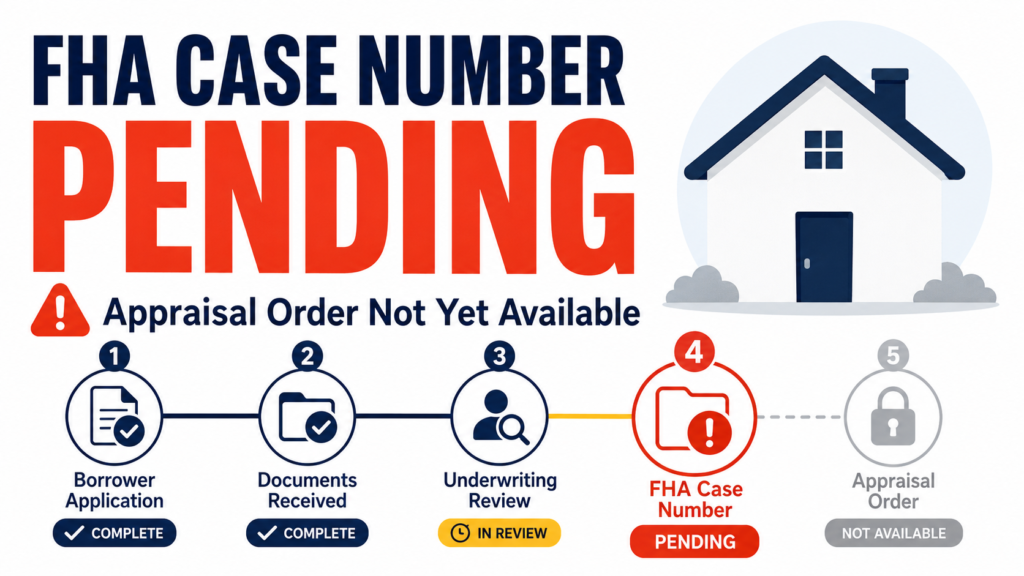
That can sound like a small administrative problem that should take five minutes to fix. Sometimes it is. Other times, the case-number request has run into an address issue, a borrower-information mismatch, a previous FHA case, or a hold that requires additional review.
Quick answer: Your lender generally needs an active FHA case number before the FHA appraisal can move through its normal ordering and submission process. A delay does not automatically mean your loan has been denied or that something is wrong with the house. It means the FHA case has not been properly established yet.
What an FHA Case Number Actually Does
An FHA case number is a unique 10-digit identifier assigned to an FHA mortgage.
It connects the borrower, property, lender, loan program, and eventual appraisal within FHA’s system. It is not simply an account number that the buyer can request independently.
The lender or another authorized FHA business partner enters the required information through FHA Connection. HUD’s current case-number assignment guidance describes this as the first step in establishing a new single-family FHA case.
For a broader explanation of what the number does throughout the transaction, read FHA Case Numbers Explained.
Why the Appraisal May Not Be Ordered Yet
The appraisal is supposed to become part of the correct FHA case file. If that case has not been established, the lender may be unable to release the appraisal order under its normal FHA process.
The appraiser usually is not causing the delay. In many cases, an appraiser has not even been assigned yet.
Here are the most common areas that can hold up the case-number assignment.
1. The Property Address Does Not Validate Correctly
FHA Connection validates property-address information against U.S. Postal Service data.
That sounds simple until the contract, appraisal system, county record, and postal address all describe the property a little differently.
Examples may include:
- A missing apartment or unit number
- An incorrect street direction, such as North instead of South
- A rural address that is entered in the wrong format
- A newly constructed home that does not yet have a recognized street address
- A ZIP code associated with more than one city or county code
- A contract address that differs from the legal or postal address
A small difference does not necessarily mean the property is ineligible. It may simply require the lender to confirm the correct information before moving forward.
2. The Borrower’s Information Does Not Match
The primary borrower’s name, Social Security number, and date of birth must be entered correctly.
Problems can occur because of:
- A misspelled legal name
- A recently changed last name
- Transposed Social Security number digits
- An incorrect birth date
- Information that does not match government records
HUD’s system also performs borrower validation against government databases. Some validation occurs overnight, so a lender may need to check the status again on the next business day.
This does not mean you should send sensitive information through an unsecured email or text message. Confirm with your lender how personal information should be corrected securely.
3. Another FHA Case May Already Exist
This is one of the biggest reasons a routine case-number request becomes confusing.
FHA Connection may find a previous case associated with the same property, borrower, or lender information.
That previous case may be connected to:
- An earlier purchase contract that fell apart
- A previous FHA buyer
- A canceled loan application
- An appraisal that may still be associated with the property
- A request previously submitted by another lender
The lender may need to determine whether the old case should be transferred, reinstated, canceled, or left alone before a new case can proceed.
If an appraisal has already been completed, the situation becomes more important because FHA appraisals are connected to the case number. Read Can an FHA Appraisal Be Reused or Transferred? before assuming a completely new appraisal can be ordered.
4. The Request Was Placed on Hold
Not every case-number request produces an immediate approval or rejection.
Some requests are placed into FHA Connection’s Holds Tracking process. The lender can use that system to identify why the request is being held and what needs to happen next.
A hold may involve:
- Pending borrower validation
- A duplicate address or duplicate request
- A prior FHA case
- Information requiring review by a HUD Homeownership Center
- A property or loan detail that needs clarification
HUD’s guidance notes that certain holds are reviewed after an overnight or 24-hour waiting period. That does not guarantee the problem will be completely resolved the next day. It means the lender should check the case status again rather than repeatedly submitting the same request.
5. The Borrower Recently Changed Lenders
Changing lenders during an FHA transaction can affect the case number and appraisal process.
If another lender already established the case, the new lender may need a case transfer rather than a brand-new case number.
That transfer is an actual FHA Connection process. It is not solved by simply changing the lender’s name on the purchase contract or ordering another appraisal.
Before switching lenders, ask:
- Has an FHA case number already been assigned?
- Has an appraisal already been ordered or completed?
- Will the case and appraisal need to be transferred?
- Who is responsible for initiating the transfer?
- How could the change affect the contract and closing dates?
A lender change may still make sense in some situations, but it should not be treated as an instant solution to a case-number delay.
6. The Property or Loan Requires Additional Information
Some FHA cases require more information than a standard existing-home purchase.
Examples include:
- Condominium units
- New or proposed construction
- Manufactured homes
- FHA-to-FHA refinances
- HUD-owned properties
- Rehabilitation loans
- Properties with multiple units or an accessory dwelling unit
The case-number request may stall when a required program code, condominium identifier, construction status, prior case number, or other property detail is missing or entered incorrectly.
That does not automatically mean the loan cannot use FHA financing. It means the lender may need to correct or complete the case information.
A Case-Number Delay Is Not the Same as an Appraisal Problem
This distinction matters.
A case-number delay happens before the appraisal can move forward normally. An appraisal problem occurs after the appraiser evaluates the property and identifies an issue with value, condition, safety, or FHA requirements.
At the case-number stage, the appraiser usually has not decided anything about the house.
The delay also does not automatically mean:
- The property failed FHA standards
- The borrower was denied
- The appraisal came in low
- The seller must make repairs
- The transaction is about to fall apart
Those may become separate issues later, but they should not be assumed merely because the case number is pending.
For an overview of what happens after the order is released, read FHA Appraisal Requirements vs. Conventional Appraisals.
What to Ask Your Lender
“We are waiting on the FHA case number” is not a complete status update.
You do not need a technical explanation of every FHA Connection screen, but you can ask for a more specific answer.
Try asking:
- Has the case-number request actually been submitted?
- Did the system return an error, warning, or hold?
- Is the problem related to the address or borrower information?
- Is there an existing FHA case connected to the property?
- Does another lender currently control the case?
- Who is responsible for the next action?
- When will the lender check Holds Tracking again?
- Could this affect the appraisal or closing deadline?
The goal is not to pressure someone into promising a date they cannot guarantee. The goal is to understand whether the request is simply pending or whether a specific correction is required.
What the Borrower Can Do
Most borrowers cannot personally access FHA Connection or assign the case number. You can still help prevent avoidable delays.
- Confirm that your full legal name is correct on the loan application.
- Review the property address, including the unit number and street direction.
- Tell the lender if you previously applied for FHA financing on the same property.
- Tell the lender immediately if another lender already ordered an FHA appraisal.
- Provide requested documents through the lender’s secure system.
- Keep your real estate agent informed if an appraisal deadline is approaching.
- Do not assume ordering a second appraisal will solve the problem.
Case-number delays are often made worse when people start creating new applications, new appraisal orders, or new lender relationships without first confirming what already exists.
What the Agent and Seller Can Do
The real estate agent can help verify that the contract contains the complete and accurate property address.
For condominiums, new construction, manufactured homes, or properties with unusual legal descriptions, the lender may need documents or details from the agent, seller, builder, title company, or homeowners association.
The seller should also understand that a pending case number is not the same as a failed appraisal.
There is usually no reason to begin making repairs before an FHA appraiser has inspected the property and the lender has reviewed the report.
How Long Does an FHA Case-Number Delay Take?
There is no single reliable timeline because the cause matters more than the label.
A simple data-entry correction may be resolved quickly. A borrower-validation hold may require an overnight system check. A previous case, lender transfer, condominium issue, or manual HUD review may take longer.
Instead of relying on a generic estimate, ask what specifically is holding the request and what must happen next.
You can also review the broader process in How Long Does an FHA Loan Take to Close? and Why FHA Loans Get Delayed and How to Avoid It.
Should You Change Lenders Because of the Delay?
Not automatically.
If the delay is caused by an incorrect address, borrower-information mismatch, or existing case, another lender may run into the same problem.
Changing lenders could also introduce a case-transfer issue and create another step before the appraisal can move forward.
If you are considering a change, ask the new lender whether it can accept the existing FHA case and appraisal, whether a transfer is needed, and how the change could affect your contract timeline.
Still comparing mortgage options? You can review available loan options through a participating mortgage provider. If you are already under contract, ask how changing lenders could affect the FHA case number and appraisal timeline before making a move.
Affiliate disclosure: Loan Under Review may earn a commission if you use the participating-provider link below. This does not guarantee approval, rates, savings, or results.
What Happens After the Case Number Is Assigned?
Once the case is properly established, the lender can move the FHA appraisal through its normal process.
The appraisal still needs to be scheduled, completed, reviewed, and submitted through FHA’s appraisal-delivery system. HUD requires appraisal reports for new FHA case numbers to be submitted through its Electronic Appraisal Delivery portal before loan endorsement.
The case number itself is not an approval.
The borrower still must qualify, the property still must meet FHA requirements, and the lender still must complete underwriting.
If a delay changes your rate-lock period or you receive a revised Loan Estimate, use the Loan Under Review mortgage calculator to compare the potential monthly-payment difference.
Frequently Asked Questions
Who assigns an FHA case number?
An FHA-approved lender or authorized FHA business partner requests the case number through FHA Connection. The buyer, seller, and real estate agent do not assign it themselves.
Does a delayed case number mean the FHA loan was denied?
No. A pending or delayed case number usually means the case has not been fully established. The lender should identify whether the request is pending, on hold, or requires corrected information.
Can an appraisal be completed before the FHA case number is assigned?
Your lender may wait to release the FHA appraisal order until the case number is active because the appraisal must be connected to the correct FHA case. Ask whether the order is pending or has not yet been created.
Can a previous FHA case number delay a new purchase?
Yes. A previous case connected to the property or borrower may need to be reviewed, transferred, reinstated, or otherwise addressed before the new transaction proceeds.
Will changing lenders solve the problem?
Not necessarily. If the issue involves the borrower, property address, or an existing FHA case, another lender may encounter the same issue. A lender change can also require a formal case transfer.
The Bottom Line
An FHA case-number delay is frustrating because it can stop the appraisal before the transaction feels like it has really started.
But the delay is usually not random.
The lender may be correcting an address, validating borrower information, reviewing a previous FHA case, completing a transfer, or responding to a system hold.
Ask for the exact status, find out who owns the next step, and avoid creating a second appraisal or lender application until you understand what already exists.
A case-number delay does not automatically mean the loan is denied or the property has failed FHA requirements. It means the administrative foundation of the FHA case still needs to be completed correctly.
Loan Under Review provides general educational information and is not a lender, mortgage broker, appraiser, or financial adviser. FHA policies and individual lender procedures can change. Confirm requirements and case-specific questions with your lender or another qualified mortgage professional.
Mortgage guidelines and lender requirements can change. This article is general education, not financial, legal, lending, or appraisal advice. Confirm requirements for your situation with an appropriate qualified professional.