On This Page
On This Page- The Numbers, Straight Up
- What's Behind the Highest Mortgage Rates in Three Years
- What 7.49% Does to Your Payment
- The Part Nobody Talks About: Your DTI
- Should You Wait Out the Highest Mortgage Rates in Three Years?
- Rate Locks: Don't Get Cute
- Refinancing Right Now Mostly Doesn't Pencil
- How to Fight Back on Your Rate
- My Bottom Line
MBA's 30-year rate hit 7.49%, the highest since November 2023. Here's what it means for your payment, DTI, rate locks and refinancing, from an underwriter's desk.
Well, here we go. We’re now looking at the highest mortgage rates in three years, and I already know the first question: “Joe, should I just wait?”
So let’s talk about it. Kitchen table, cup of coffee, no sales pitch.
The Numbers, Straight Up
Quick heads-up first. You’ll see a few different “mortgage rate” numbers this week. They come from different surveys with different methods, so they won’t match. That’s normal, and they aren’t interchangeable.
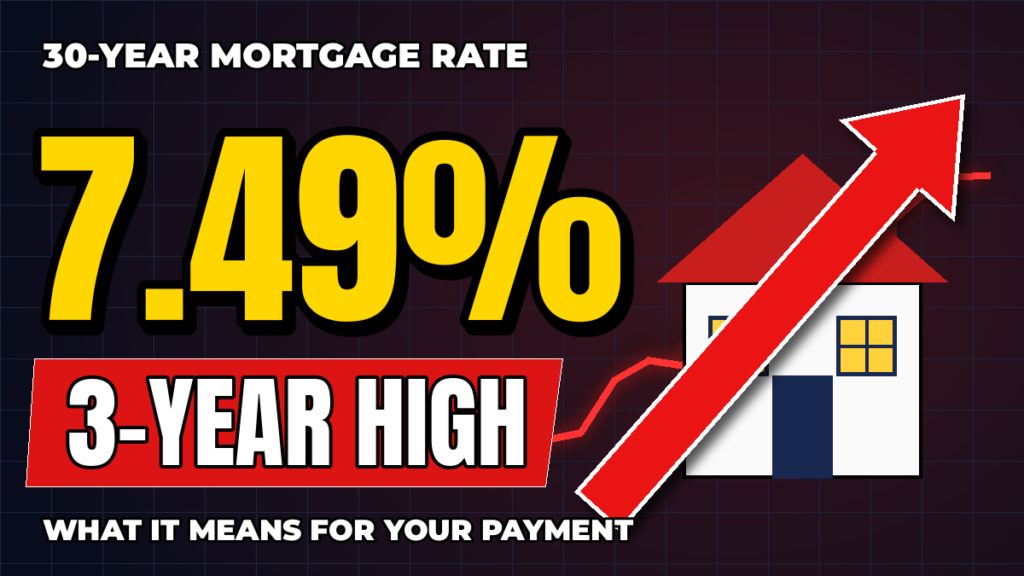
MBA’s weekly survey. On Oct. 7, the Mortgage Bankers Association reported that its average 30-year fixed rate hit 7.49% for the week ending Oct. 2. That’s up from 7.30% the week before, and it’s the highest since November 2023. So technically, it’s almost three years. MBA’s Sept. 30 release counted six straight weekly increases, so this one makes seven. For comparison, MBA had the same rate at 6.43% for the week ending Oct. 3, 2025.
Freddie Mac’s weekly survey. Freddie Mac’s PMMS, released at noon on Oct. 8, put the 30-year fixed at 7.40%. That’s up from 7.28% on Oct. 1 and 7.03% on Sept. 24. It’s also Freddie’s seventh straight weekly increase and its highest reading since November 2023. A year ago, Freddie had it at 6.30%.
Bankrate’s daily average. On the morning of Oct. 8, Bankrate’s national average for a 30-year fixed was 7.55%.
Different methods, different numbers. Still, they all point the same direction. Up.
Borrowers noticed, too. In MBA’s Oct. 7 release, total applications fell 4.2% from the week before. Purchase applications dropped 2%, while refinance applications fell 8%. Refis were also 56% lower than the same week a year ago, and MBA said they hit their lowest level since 2025.
What’s Behind the Highest Mortgage Rates in Three Years
First, a quick refresher, because this trips people up. Mortgage rates don’t follow the Fed’s rate directly. Instead, they move with Treasury yields, prices for mortgage-backed securities (MBS), the spread between the two, and each lender’s own pricing. I explain more in my post on why the 10-year Treasury yield matters.
Here’s what’s documented:
- Treasury yields climbed. According to Treasury’s daily yield data, the 10-year closed at 5.31% on Oct. 5. That’s its highest close since May 2002. Then the 30-year closed at 5.67% on Oct. 7, its highest in more than two decades.
- Spreads widened, too. MBA’s Joel Kan said rates rose “as both Treasury rates increased and spreads widened with the increase in rate volatility.”
- The Fed raised rates. On Sept. 16, the Fed raised its benchmark rate by a quarter point to 3.75%–4.00%. That was its first hike since July 2023, according to the Fed’s rate history.
- Inflation is running hot. The BLS August CPI report showed prices up 3.4% from a year earlier. Energy prices alone were up 16.3%.
Beyond that, other factors may be in the mix. For example, news reports tie part of the bond selloff to higher oil prices amid tensions with Iran. The Fed also described growth as “solid” and pointed to geopolitical uncertainty. Still, nobody can pin this on one single cause.
Put it all together, and MBA’s 30-year rate is up 1.4 points since late February. It sat at 6.09% for the week ending Feb. 27, according to MBA’s March 4 release.
What 7.49% Does to Your Payment
Here’s what the highest mortgage rates in three years do to an actual payment.
Say you buy a $430,000 house with 20% down. That’s $86,000 down and a $344,000 loan on a 30-year fixed. At 6.43%, MBA’s rate a year earlier, principal and interest runs about $2,159 a month. At 7.49%, it’s about $2,403.
That’s roughly $244 more a month, call it $250, for the same house and the same down payment. And that’s only principal and interest. It doesn’t include property taxes, homeowners insurance, HOA dues, or other housing costs.
Want to run your own numbers? Try our mortgage calculator. Then check the cash-to-close calculator so you know what you need on closing day.
The Part Nobody Talks About: Your DTI
This is where my underwriter brain kicks in. A higher rate doesn’t just cost more. It can change whether you qualify at all.
Because your debt-to-income ratio (DTI) includes the new house payment, every bump in rate pushes your DTI up.
For example, say your lender allows a maximum debt-to-income ratio of 45%. If your mortgage payment increases by $250 per month, you’d need approximately $556 more in gross monthly qualifying income to offset that increase and maintain the same DTI.
Nothing else about your financial situation changed. Your income is the same, your credit hasn’t changed, and you haven’t taken on additional debt. But that higher mortgage payment could be enough to affect your loan approval.
Just so we’re clear, that 45% is only an example. It’s not a universal FHA or conventional limit. Your actual qualifying ratios depend on the loan program’s rules, your automated underwriting findings, and your lender’s own overlays.
I dug into this in my post on how higher rates hit DTI and buying power. The short version? If your pre-approval is more than a few weeks old, have your lender run it again.
Should You Wait Out the Highest Mortgage Rates in Three Years?
Honestly, I can’t tell you where rates go next. Nobody can, and anyone who says they know for sure is selling something.
Instead, here’s how I’d think about it. Buy when the payment works for your budget today. Don’t count on some future refinance to bail you out. If the house only works at a rate that doesn’t exist yet, that’s not a plan. That’s a wish.
What about competition? Fewer applications don’t automatically mean fewer buyers fighting over your house, especially when refis drive much of the drop. Higher rates can shrink buying power, though, and that could soften competition in some markets. Even so, local inventory, demand and pricing matter more than any national number. So don’t assume you’ll have extra negotiating leverage. Ask your agent what’s actually happening on your street.
Rate Locks: Don’t Get Cute
If you’re already under contract, talk to your loan officer about locking. MBA’s and Freddie Mac’s 30-year averages have both risen seven weeks straight. Gambling on a dip and getting it wrong can cost you real money.
Also, ask how long the lock lasts and what an extension costs. Deals get delayed, and appraisals come back late. That’s why you want a lock that covers your closing date with a little cushion.
Refinancing Right Now Mostly Doesn’t Pencil
MBA’s refinance index was 56% lower than the same week a year ago. That tracks. If you’ve got a rate in the 5s or 6s, trading it for something in the mid-7s rarely makes sense.
Kan, the MBA’s deputy chief economist, said it plainly: “Very few homeowners have an incentive to refinance at these rates, and the jump in borrowing costs has caused many potential borrowers to step back from the purchase market.”
Of course, there are exceptions. For example, you might need to take an ex-spouse off the loan after a divorce. Even then, run the numbers hard first.
How to Fight Back on Your Rate
You can’t control the bond market. However, you can control a few things.
- Shop more than one lender. Get quotes on the same day, then compare them line by line with our Loan Estimate comparison calculator.
- Ask about points. Buying down your rate can work if you’ll keep the loan long enough. Our mortgage points break-even calculator shows how long that takes.
- Ask the seller for a temporary buydown. A seller credit can lower your payment for the first year or two. Just know underwriting usually still qualifies you at the full note rate.
- Pay down debt before you apply. Lower monthly debts help your DTI, so even a small payoff can matter.
For scale, every quarter point on that $344,000 loan is worth about $59 a month. So yes, shopping matters.
My Bottom Line
The highest mortgage rates in three years stink. I’m not going to sugarcoat it. Even so, it’s not a reason to panic.
Know your numbers first. Next, get a fresh pre-approval if rates moved since your last letter. Finally, buy what you can afford today, based on a payment you can live with now, not a rate you hope shows up later.
This is general information, not financial advice. Your loan officer can price your actual scenario.
Mortgage guidelines and lender requirements can change. This article is general education, not financial, legal, lending, or appraisal advice. Confirm requirements for your situation with an appropriate qualified professional.