On This Page
On This Page- What Exactly Is FHA Changing?
- So Why Does FHA Want New Credit Scores?
- Your Credit Score Could Be Different Depending on the Model
- What Makes FICO 10T Different?
- Does This Mean FHA Loans Will Be Easier to Get?
- FHA's TOTAL Scorecard Is Also Important Here
- The Date Is Based on the FHA Case Number
- Fannie Mae and Freddie Mac Are Changing Too
- What Should Homebuyers Do Right Now?
- What About Buyers With Limited Cash?
- The Question Borrowers May Start Asking in 2027
- What Happens Next?
- Official Sources
FHA is adding VantageScore 4.0 and FICO Score 10T to its mortgage underwriting system beginning January 1, 2027. Here's what is changing, what is not, and why borrowers may soon need to ask which credit score their lender is using.
For a very long time, mortgage credit scores have basically meant one thing: FICO.
That is starting to change.
The Federal Housing Administration has now set a firm implementation date for one of the biggest changes to mortgage credit scoring in years.
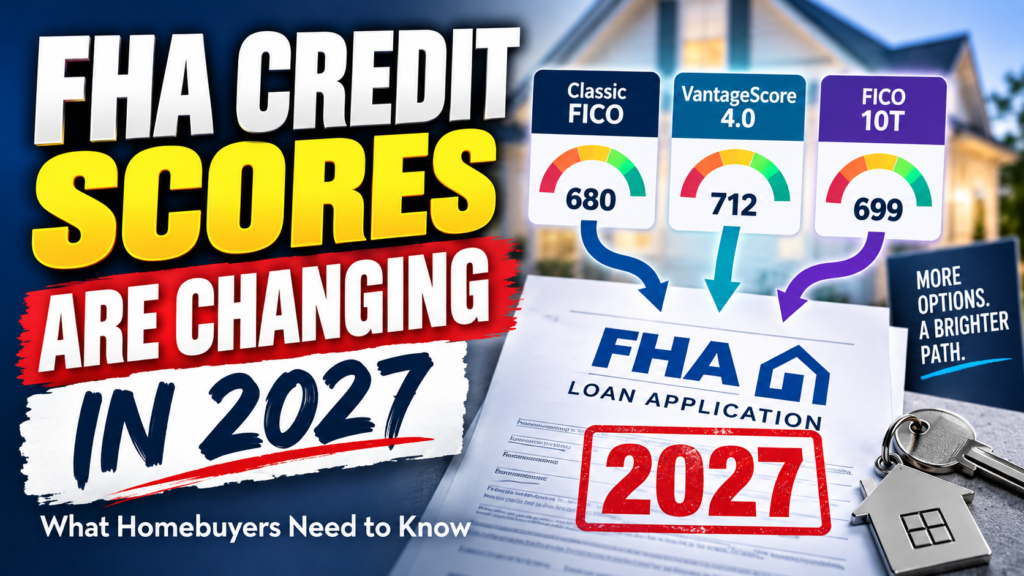
Beginning January 1, 2027, FHA will allow VantageScore 4.0 and FICO Score 10T to be used alongside the Classic FICO models already used in FHA mortgage underwriting.
And before anyone gets too excited, this does not mean FICO is disappearing.
It also does not mean everyone is suddenly going to qualify for an FHA loan.
What it does mean is that the score being used to evaluate a mortgage borrower may no longer be as simple as it has been in the past.
What Exactly Is FHA Changing?
On September 10, 2026, FHA announced that its updated TOTAL Mortgage Scorecard will go into effect for eligible FHA Title II forward mortgages with case numbers assigned on or after January 1, 2027.
The updated system will support three eligible credit scoring models:
- Classic FICO
- VantageScore 4.0
- FICO Score 10T
That wording matters.
FHA is not replacing Classic FICO. It is adding additional models that lenders can use within the FHA underwriting process.
For borrowers who want a deeper look at how credit currently works on FHA loans, we already break that down in our guide to minimum FHA credit score requirements.
So Why Does FHA Want New Credit Scores?
Mortgage lending has relied on older versions of FICO for decades while the way people actually use credit has changed considerably.
Consumers now use credit cards, installment debt, rent payments and other obligations differently than they did when many of the older scoring models were developed.
Newer models such as VantageScore 4.0 and FICO 10T are designed to analyze credit risk using more modern data and modeling techniques.
FHFA has also said the newer models can incorporate additional information, including rental payment history.
That could matter for someone who pays $1,800 in rent every month like clockwork but has a relatively thin traditional credit profile.
It does not guarantee that person’s mortgage score will suddenly jump.
But it gives the scoring model more information to work with.
Your Credit Score Could Be Different Depending on the Model
This is probably the part borrowers need to understand most.
You do not really have one universal credit score.
You can have different scores depending on:
- The credit bureau
- The scoring company
- The version of the scoring model
- The type of credit being evaluated
So the score you see through a free credit monitoring app is not necessarily the same score a mortgage lender sees.
And beginning in 2027, even two mortgage lenders reviewing the same borrower may potentially be working with different approved scoring models depending on how FHA’s implementation develops.
Same borrower.
Same credit history.
Potentially a different score.
That is where this gets interesting.
What Makes FICO 10T Different?
One of the major differences with FICO 10T is its use of trended credit data.
Instead of simply looking at a snapshot of where certain accounts stand today, trended data can help show how balances and payment behavior have changed over time.
For example, imagine two borrowers both have a $4,000 credit card balance today.
Borrower A has spent the last year reducing the balance from $10,000.
Borrower B has spent the last year increasing the balance from $500.
A traditional snapshot sees two $4,000 balances.
A model using trended data can see two very different patterns.
That does not tell us exactly how either borrower will be scored, but it helps explain why newer models may produce a different result than Classic FICO.
Does This Mean FHA Loans Will Be Easier to Get?
Not necessarily.
This is where the headlines can get ahead of what FHA actually announced.
A new scoring model does not erase the rest of underwriting.
FHA loans still have to be reviewed for things like:
- Income
- Employment
- Credit history
- Monthly debts
- Debt-to-income ratio
- Assets
- Property eligibility
- Appraisal requirements
A credit score is one piece of the file.
It is an important piece, but it is not the entire loan approval.
If you have ever wondered why an underwriter is asking for documents that seem completely unrelated to your credit score, our guide to what FHA underwriters are really looking for explains the rest of that process.
You can also review our complete breakdown of FHA loan requirements in plain English.
FHA’s TOTAL Scorecard Is Also Important Here
There is another piece of this announcement that is easy to miss.
FHA’s TOTAL Mortgage Scorecard is the system used to evaluate FHA borrower credit and application information through an automated underwriting system.
TOTAL itself is not the lender’s AUS.
It works through systems used by lenders and provides an FHA underwriting classification.
The updated version that supports the additional credit models is scheduled to become available January 1, 2027.
FHA specifically says the change applies to eligible Title II forward mortgages scored through TOTAL.
That is important because this is not simply a universal change affecting every FHA transaction in exactly the same way.
The Date Is Based on the FHA Case Number
Here is the little underwriting detail that will probably disappear from half the articles written about this.
The January 1 date is tied to the FHA case number assignment.
The updated TOTAL Scorecard applies to eligible loans with FHA case numbers assigned on or after January 1, 2027.
That is different from saying, “I applied for my mortgage in January.”
The case number date matters.
Fannie Mae and Freddie Mac Are Changing Too
This is not just an FHA story.
Mortgage credit scoring is changing on the conventional side as well.
As of September 9, 2026, all approved Fannie Mae and Freddie Mac lenders may use VantageScore 4.0 when originating and selling eligible loans to the Enterprises.
Previously, its use had been part of a more limited rollout.
Classic FICO is still allowed.
FICO 10T has also been approved as part of the broader modernization effort, but FHFA says it is not currently eligible for conventional loan delivery. Additional implementation guidance is still expected.
So we’re clearly heading toward a mortgage industry where one credit score model no longer dominates everything.
What Should Homebuyers Do Right Now?
Probably less than the internet is going to tell you.
If you are planning to buy a house before January 2027, I would not delay a mortgage application because you’re hoping a different scoring model magically produces a higher number.
There is absolutely no guarantee that it will.
The boring stuff still works:
- Pay your bills on time.
- Keep revolving balances under control.
- Avoid opening unnecessary credit immediately before applying.
- Do not assume the score in a consumer app is your mortgage score.
- Keep documentation for major financial changes.
Your credit score also does not tell you what your complete mortgage picture looks like.
If you’re trying to understand how income, debts and payment estimates work together, you can use the Loan Under Review mortgage calculators to run your own scenarios.
What About Buyers With Limited Cash?
A different credit score does not change another reality of buying a home: qualifying for the loan and having enough money to close are two separate problems.
Your down payment, closing costs, prepaid expenses, credits and earnest money can all affect the amount you actually need at closing.
If you are starting to plan a purchase, our Cash-to-Close Calculator can help estimate how those pieces fit together.
The Question Borrowers May Start Asking in 2027
For years, borrowers have asked:
“What’s my credit score?”
That question may soon need a follow-up.
“Which credit scoring model are you using?”
Because a 680 generated by one scoring model does not automatically mean another model will generate the exact same number.
And as mortgage lenders begin adopting additional approved models, borrowers may hear names like Classic FICO, VantageScore 4.0 and FICO 10T a lot more often.
What Happens Next?
FHA is giving lenders, credit providers and mortgage technology companies the rest of 2026 to prepare for the January rollout.
FHA has also announced industry office hours ahead of implementation and says additional FAQs will accompany the updated TOTAL Scorecard.
There will almost certainly be more guidance between now and January.
But the direction is already pretty clear.
Mortgage lending is moving away from a system where one aging credit scoring model controls nearly everything.
That does not mean underwriting suddenly becomes easy.
It does mean the number sitting at the top of your credit report may finally have some competition.
Official Sources
- U.S. Department of Housing and Urban Development: FHA TOTAL Mortgage Scorecard
- HUD: FHA INFO 2026-21
- Federal Housing Finance Agency: Credit Score Modernization
Loan Under Review provides independent mortgage education and is not a lender. Mortgage guidelines, lender requirements and underwriting practices can vary. Always confirm requirements for your specific loan with your lender or mortgage professional.
Mortgage guidelines and lender requirements can change. This article is general education, not financial, legal, lending, or appraisal advice. Confirm requirements for your situation with an appropriate qualified professional.