
On This Page
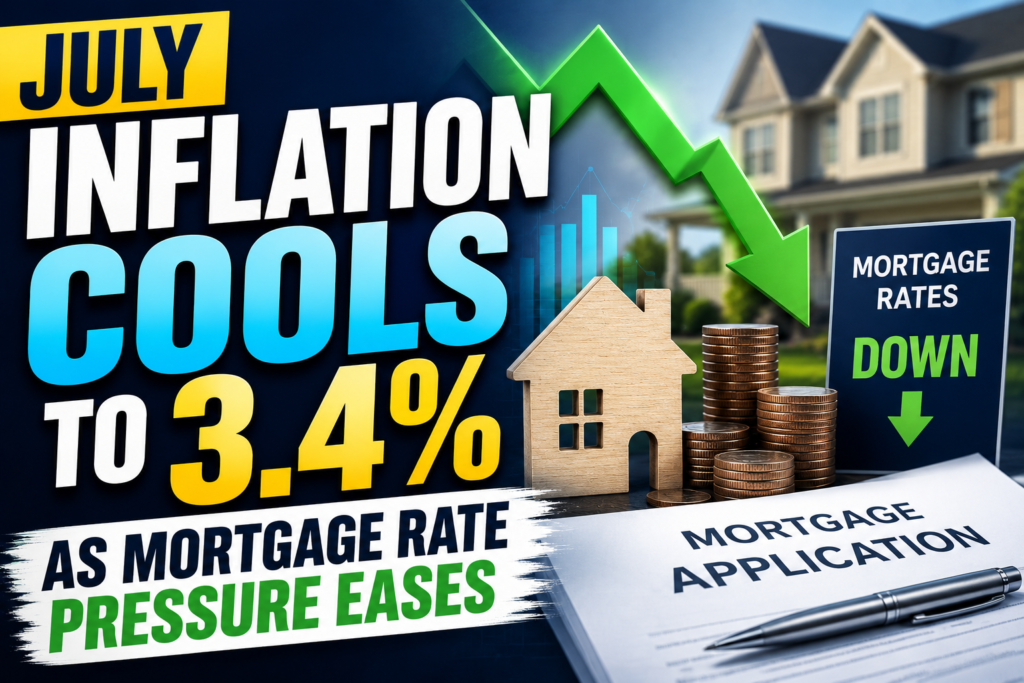
On This PageJuly inflation cooled to 3.4%, giving the mortgage market a little breathing room. That does not guarantee lower rates, but it may reduce the risk of another sharp move higher.
Mortgage rates didn’t suddenly become cheap because of one inflation report.
But homebuyers finally got a piece of economic news that could take at least a little pressure off borrowing costs.
The Consumer Price Index rose just 0.1% in July, according to the U.S. Bureau of Labor Statistics. Compared with a year earlier, consumer prices were up 3.4%, slightly below June’s 3.5% annual inflation rate.
Core inflation, which removes the more volatile food and energy categories, came in at 2.5% year over year.
For anyone watching mortgage rates, that matters.
Inflation cooled, but it definitely hasn’t disappeared
The July report was relatively calm compared with some of the inflation numbers borrowers have been dealing with this year.
Shelter costs increased 0.1% during the month and accounted for roughly two-thirds of the overall monthly CPI increase. Food prices also rose 0.1%.
Energy moved in the other direction, falling 1.5% in July. Gasoline prices dropped 2.9% for the month.
There’s still plenty of inflation in the system. Energy prices, for example, were 14.7% higher than a year earlier.
So nobody at the Federal Reserve is hanging a “mission accomplished” banner quite yet.
Still, inflation moving from 3.5% to 3.4% is a lot better for the mortgage market than seeing it jump back toward 4%.
Why mortgage rates care about inflation
One of the biggest misconceptions in mortgage lending is that the Federal Reserve directly sets mortgage rates.
It doesn’t.
The Fed sets a short-term benchmark interest rate. Thirty-year mortgage rates are influenced much more directly by the bond market, including Treasury yields and mortgage-backed securities.
But inflation is a huge part of that equation.
When investors believe inflation is getting worse, they generally want higher yields to compensate for the loss of purchasing power over time. That pressure can eventually show up in mortgage pricing.
When inflation behaves better than expected, some of that upward pressure can ease.
That’s why a seemingly small move in CPI can matter to somebody trying to buy a house.
The Fed was already debating whether rates should go higher
At its July 28–29 meeting, the Federal Reserve kept the federal funds target range at 3.5% to 3.75%.
What made that meeting interesting was the vote.
Three members wanted the Fed to raise rates by another quarter percentage point.
In other words, the discussion wasn’t about when rates would be cut. Some policymakers were still arguing they needed to go higher.
The Fed also said inflation remained elevated compared with its 2% objective.
That makes another softer inflation reading useful.
It doesn’t guarantee the Fed will leave rates alone at its September meeting, but it gives policymakers another piece of evidence that inflation isn’t suddenly accelerating again.
Does this mean mortgage rates are about to fall?
No guarantee whatsoever.
Mortgage rates can move even when the Fed does nothing.
Treasury yields, economic growth, employment reports, global events, investor demand and expectations about future inflation can all move mortgage pricing from one day to the next.
That’s why predicting a specific mortgage rate based on one CPI report is usually a great way to be confidently wrong.
What the July inflation report may do is reduce the risk of another sudden inflation-driven surge in rates.
Mortgage Professional America reported a similar view from First American senior economist Sam Williamson, who said softer inflation could give homebuyers more certainty around borrowing costs.
That certainty has value.
A buyer can plan around a mortgage rate that stays in a relatively narrow range.
It’s much harder when rates are jumping around while you’re trying to make an offer, negotiate a purchase and figure out whether the monthly payment still works.
Homebuyers still need to shop the actual loan
Even if national mortgage rates improve, two borrowers can still receive very different mortgage offers on the same day.
Credit score matters. So does down payment, loan type, property type, occupancy, points, lender pricing and even the structure of the transaction.
Someone using FHA financing may also see a very different combination of interest rate, mortgage insurance and upfront costs than someone using conventional financing.
If you’re comparing those two options, our FHA vs. conventional loan guide walks through the differences in plain English.
And don’t obsess over a national headline rate without looking at the actual Loan Estimate.
A slightly lower advertised rate with thousands of dollars in discount points isn’t automatically the better mortgage.
What borrowers should watch next
The Federal Reserve’s next scheduled policy meeting is September 15–16.
Before then, policymakers will get more inflation data, employment numbers and other economic reports.
Any of those could change the conversation again.
For now, July’s inflation report gives the housing market something it hasn’t had much of lately: a little less reason to worry about rates suddenly taking another run higher.
For buyers who have spent months watching mortgage rates like a heart monitor, a boring stretch would actually be pretty good news.
Sources: U.S. Bureau of Labor Statistics, Federal Reserve, and Mortgage Professional America.
Mortgage guidelines and lender requirements can change. This article is general education, not financial, legal, lending, or appraisal advice. Confirm requirements for your situation with an appropriate qualified professional.